





A defined jawline and a smooth neckline change how a face reads at every angle. Those two results are what bring most patients into a neck lift consultation in Reading (opens in a new tab) with board-certified plastic surgeon Matthew Hagan, MD, FACS (opens in a new tab) at Berks Plastic Surgery. Below, Dr. Hagan answers the neck lift FAQs he hears most in consultation, in the order most patients actually ask them.
Do I Need a Facelift, a Neck Lift, or Both?
The jaw and cheeks can age differently than the neck, so the right procedure depends on where the changes actually show up. A neck lift, whether performed as cervicoplasty (skin removal), platysmaplasty (tightening the vertical muscle bands that can show through the skin), or both, addresses loose skin, muscle banding, and fullness below the chin. A facelift (opens in a new tab) addresses sagging in the midface, jowls, and cheeks.
Patients with aging concentrated in the neck, sometimes described as a “turkey neck” or double chin, are often strong candidates for a neck lift alone. Patients with both facial and neck laxity often combine a facelift with a neck lift in one procedure. Dr. Hagan examines skin elasticity, muscle tone, and bone structure at the consultation to recommend the combination that matches a patient’s goals.
Are There Non-Surgical Alternatives to Neck Lift Surgery?
Non-surgical treatments, such as radiofrequency skin tightening and injectable fat-reduction treatments, work by tightening existing tissue or reducing fat volume, which can improve mild fullness under the chin or early skin laxity (loose, less elastic skin). They do not remove excess skin the way a neck lift does.
Some patients may have fullness in their neck that doesn’t necessitate a formal neck lift. There are minimally invasive options as well, including liposuction (opens in a new tab) and FaceTite skin tightening (opens in a new tab), that may benefit patients who may not require a standard neck lift.
The American Society of Plastic Surgeons (opens in a new tab) recognizes neck lift surgery specifically as the established treatment once skin laxity or muscle banding becomes more pronounced. Dr. Hagan reviews both surgical and non-surgical paths at consultation so a patient’s anatomy, not just preference, drives the recommendation.
How Is a Neck Lift Different for Men?
We recently shared this result on our Instagram: a male patient with a more defined jawline and a smoother neckline from a direct neck lift, Dr. Hagan’s technique for addressing loose skin and muscle banding through a single, carefully placed incision under the chin.
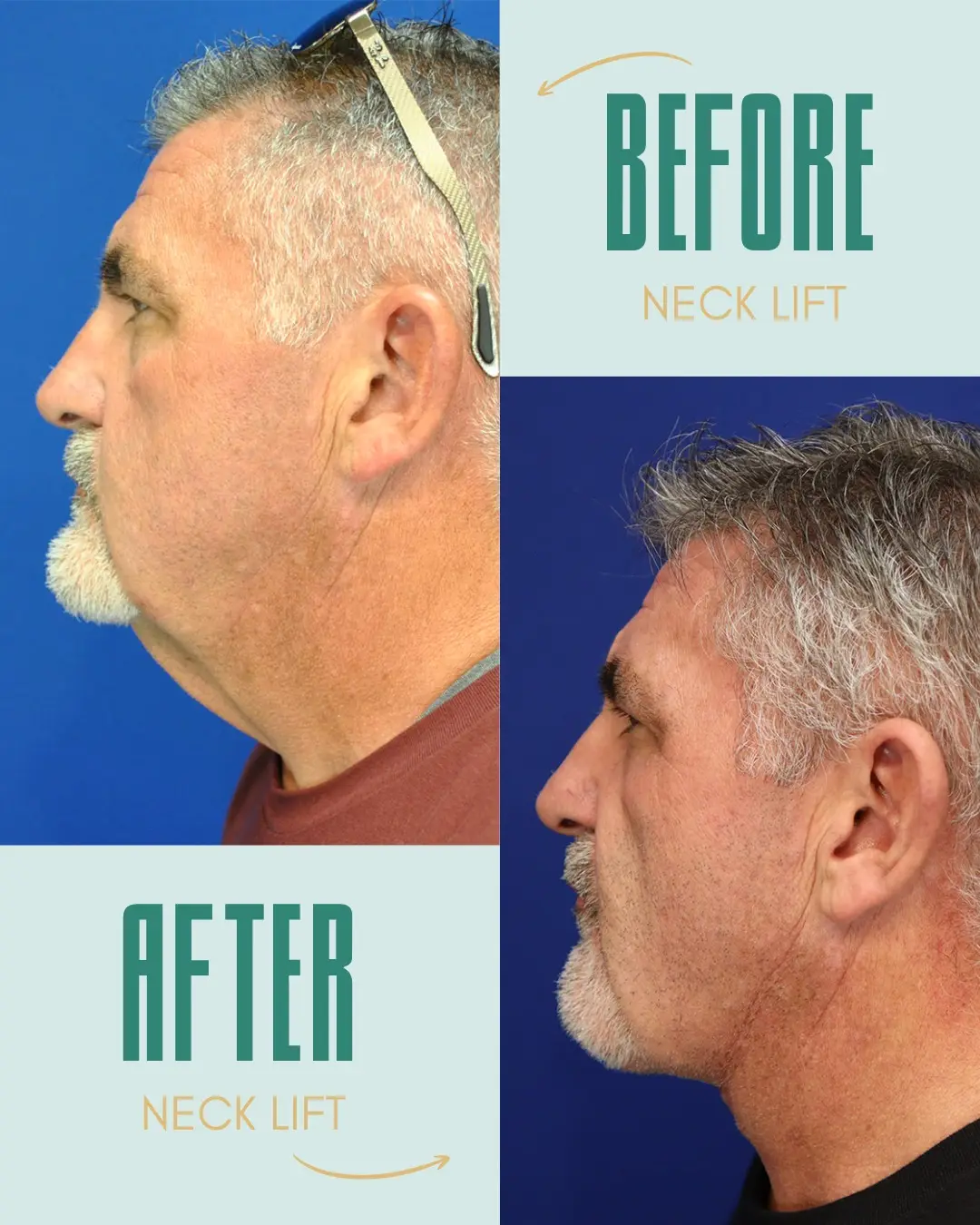
A more defined jawline and a smoother neckline after a direct neck lift with Dr. Matthew Hagan. See the post on Instagram (opens in a new tab)
It’s a common fit for male patients specifically because men’s neck anatomy calls for different surgical planning than women’s. Thicker skin, denser muscle banding, and beard-bearing skin all affect incision placement and technique, and Dr. Hagan positions incisions to stay concealed within the hairline and beard pattern where possible, so results read as natural rather than surgical.
The procedure itself is performed on an outpatient basis, generally taking two to three hours under anesthesia suited to how much correction a patient needs. Consultations follow the same discreet, straightforward approach many male patients prefer, focused on results and recovery rather than trends.
When Can You Return to Work After a Neck Lift?
Most patients return to desk-based work within one to two weeks of a neck lift. Swelling and bruising are most noticeable during the first 10 days and continue to improve over the following weeks.
Patients with more physically demanding jobs should plan for a longer break, and Dr. Hagan provides a recovery timeline tailored to each patient’s procedure and occupation at consultation. Here is what recovery typically looks like:
- Days 1 to 10: Swelling and bruising are most visible; most patients rest at home and limit strenuous activity.
- 1 to 2 weeks: Most patients return to desk-based work and light daily routines.
- Weeks 2 to 6: Residual swelling continues to resolve; patients gradually resume more strenuous activity with Dr. Hagan’s guidance.
- Up to 6 months: Final results continue to refine as the last of the swelling resolves, though many patients see their result take clear shape by around three months.
Will Your Neck Motion Be Limited After a Neck Lift?
Temporary tightness is normal in the first few weeks after a neck lift, especially when turning the head or looking down. This tightness is not a permanent restriction.
Most patients notice it easing within two to three weeks, well before the swelling fully resolves and the final result is visible. As the tightened muscle and skin settle into place, patients regain their full, normal range of motion. Dr. Hagan reviews expected sensations, including tightness and numbness, at consultation so patients know what to expect during healing.
How Can You Make Your Results Last Longer?
Neck lift results are considered long-lasting, though the natural aging process continues after any procedure. Sun protection, a stable weight, and a consistent skincare routine with potent active ingredients (like Vitamin C and retinol) all help protect the results of a neck lift over time.
Berks Plastic Surgery offers a full-service medspa where many of our neck lift and facelift patients receive periodic non-surgical maintenance treatments to preserve their results as they continue to age naturally. Treatments like wrinkle relaxers (opens in a new tab) (i.e. Botox) can prevent the formation of lines and wrinkles, while treatments like laser skin resurfacing (opens in a new tab) and Morpheus8 RF microneedling (opens in a new tab) build collagen to promote firm skin while minimizing sun damage and evening tone on the surface.
Significant weight fluctuation can stretch the skin and muscle that Dr. Hagan tightened during surgery, so maintaining a stable weight matters more than any single product or treatment. For this reason, Dr. Hagan recommends achieving your weight loss goal prior to undergoing a neck lift. Dr. Hagan schedules follow-up visits throughout the first year to track healing and address any concerns as results settle in.
Ready to take the next step toward your confidence goals?
Matthew Hagan, MD, FACS, is a board-certified plastic surgeon, certified by both the American Board of Plastic Surgery (ABPS) and the American Board of Surgery (ABS). He is a Fellow of the American College of Surgeons and a member of the American Society of Plastic Surgeons (ASPS) and The Aesthetic Society. Schedule a consultation with Dr. Hagan at Berks Plastic Surgery by calling (610) 320-0200 or requesting an appointment online.
