





Nearly every rhinoplasty is performed one of two ways: open or closed. Both can reshape the bone and cartilage that give your nose its shape. Each also has things it does well and places where it falls short, so the right choice changes from one nose to the next.
Choosing between open rhinoplasty vs. closed rhinoplasty is one of the first decisions you’ll make in a consultation for rhinoplasty in Reading (opens in a new tab) with board-certified plastic surgeon Matthew Hagan, MD, FACS (opens in a new tab) at Berks Plastic Surgery.
Below, Dr. Hagan explains how open and closed rhinoplasty differ and when he recommends each approach.
What Is the Difference Between Open and Closed Rhinoplasty?
Both techniques can reshape the bone and cartilage that give your nose its shape. They differ in how Dr. Hagan reaches that framework to achieve your desired look.
Incision Placement
An open rhinoplasty adds a small incision across the columella (the narrow strip of tissue between your nostrils) and connects it to incisions inside your nose. A closed rhinoplasty keeps every incision inside the nostrils, so there is no incision on the outside of the nose.
Visibility During Surgery
In an open rhinoplasty, the columellar incision lets Dr. Hagan gently lift the skin of the nose and look directly at the cartilage and bone underneath. A closed rhinoplasty is done through the internal incisions alone, which gives a narrower view and shows less of the nasal anatomy at once.
Access to the Nasal Structure
That direct view affects how much reshaping is possible. Reducing an overly large nose may involve removing bone or cartilage, while other noses need cartilage added for support. With an open approach, Dr. Hagan can sculpt the entire nasal framework and place complex cartilage grafts with more precision. A closed approach still allows meaningful reshaping, but the more limited access makes it better suited to smaller, more targeted changes.
Open or closed, the goal stays the same. Dr. Hagan works to refine and reshape your nose while maintaining as much as the integrity of your nose as possible.
Open or closed, the goal stays the same. You want a nose that looks like it was always yours.
When Is Open Rhinoplasty the Better Choice?
Open rhinoplasty is usually the better choice when your nose needs detailed or structural work. The added visibility matters most in these cases.
Tip refinement. The nasal tip is shaped by cartilage. An open approach gives Dr. Hagan a greater view of the tip structures, which helps when reshaping them precisely.
Cartilage grafts. Some noses need added support or shape, using small pieces of cartilage. Graft cartilage most often comes from the septum (the wall that divides the inside of your nose), occasionally from the ear, and only rarely from a rib. Seeing the framework directly allows Dr. Hagan to place complex grafts more accurately.
Structural work. Significant changes to the size or shape of the nose, or correcting structural problems that affect breathing, call for a clear view of how every part fits together. A deviated septum is one of the most common causes of breathing problems, and functional rhinoplasty can also address enlarged turbinates (the ridges of tissue along the inside walls of the nose) or a collapsing internal nasal valve.
Revision rhinoplasty. A second surgery to correct or improve a previous rhinoplasty is often performed with an open approach. Revision surgery is more complex than a first-time rhinoplasty, and the full view helps Dr. Hagan assess what needs to change.
When Is Closed Rhinoplasty Enough?
A closed rhinoplasty can be enough when the changes you want are modest. A 2022 systematic review in Archives of Plastic Surgery notes that closed rhinoplasty has been popular with patients who want minor changes to the size and shape of their nose or small modifications to the bridge.
Because every incision stays inside the nostrils, a closed rhinoplasty leaves no visible external incision, and closed procedures typically take less time to perform. It still involves incisions and a healing period; they just sit inside the nose. With less direct access to the nasal structure, though, the closed approach suits more limited changes, and it usually isn’t the right fit for noses that need complex grafting or major restructuring.
“I had my first procedure done at Berks Plastic Surgery and am so happy with the results. Dr Hagan is awesome and shows genuine care for his patients. The entire staff is wonderful… I would definitely recommend Berks Plastic Surgery!”
How Dr. Hagan Chooses the Right Approach
At your consultation, Dr. Hagan evaluates your nasal anatomy, skin thickness, breathing, and goals. Breathing matters as much as shape here. Surgery to improve a blocked airway requires a careful look at how the structure of your nose affects airflow. Together, you and Dr. Hagan review your photographs to show how your nose may change after surgery, so you both share the same vision for the result.
The plan comes first, and the technique follows. Dr. Hagan first decides what your nose needs, whether that’s a more refined tip, a straighter septum, or both. Then he chooses the approach that can deliver it most precisely. For some patients, that’s a closed rhinoplasty. For others, an open approach is the better way to reach the result.
What Each Approach Means for Scarring and Recovery
The closed approach leaves no external scar. The open approach leaves a small scar on the columella, but it sits on the underside of the nose, where it is only seen from below. The columellar incision typically heals to a fine, barely visible line, though healing varies from person to person.
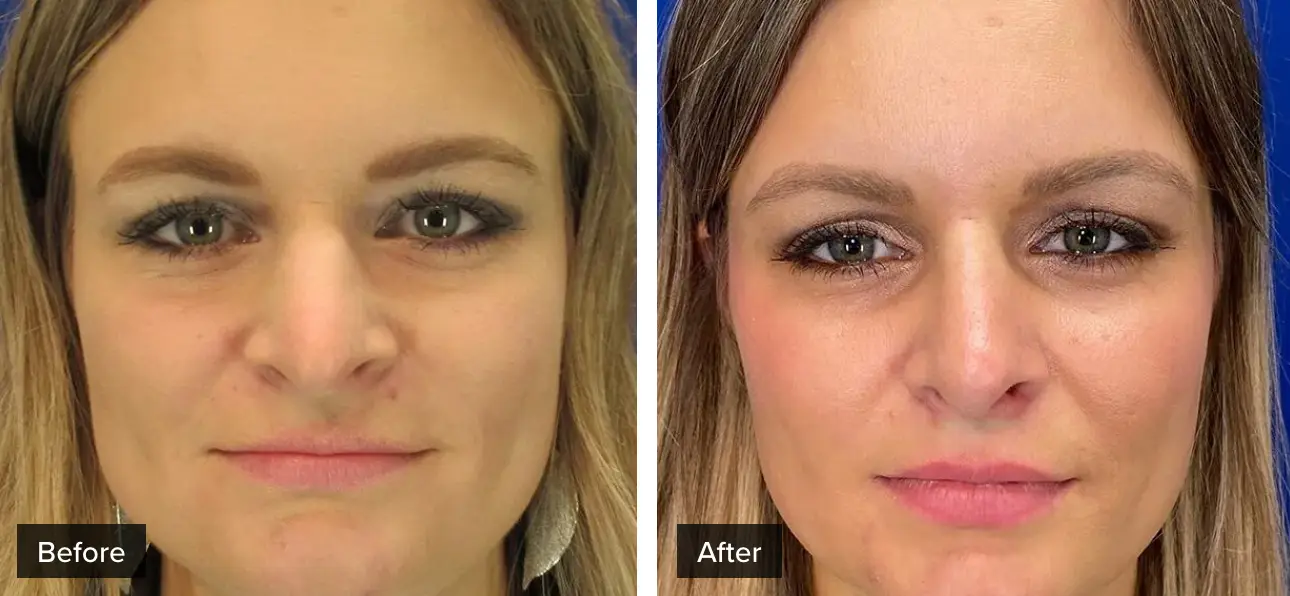
Before and after rhinoplasty with Dr. Hagan
Open rhinoplasty often means more swelling early on, and the tip is usually the last area to settle. The overall recovery phases stay similar with either approach. Initial swelling subsides within a few weeks (opens in a new tab), but your new nasal contour can take up to a year to fully refine. During that first year, swelling may come and go, and it often looks worse in the morning just after you’ve woken up—don’t worry, that’s a normal part of healing.
Here is what recovery typically looks like:
- Days 1 to 7: Swelling and bruising around the eyes peak around day three. Your external splint usually comes off around day six or seven.
- Weeks 2 to 3: Most visible bruising fades, and many patients feel comfortable returning to desk work and light social activity.
- Weeks 4 to 6: Dr. Hagan typically clears more intense exercise once healing is on track.
- Up to 1 year: The final shape continues to refine as the last of the swelling resolves.
While your nose heals, protect it from sun exposure and accidental bumps, and keep every follow-up appointment so Dr. Hagan can monitor your progress. For a stage-by-stage breakdown, read Dr. Hagan’s guide to rhinoplasty recovery (opens in a new tab).
View more rhinoplasty before and afters
Discuss which technique is best for you with Dr. Matthew Hagan
Matthew Hagan, MD, FACS, is a board-certified plastic surgeon, certified by both the American Board of Plastic Surgery (ABPS) and the American Board of Surgery (ABS). He is a Fellow of the American College of Surgeons and a member of the American Society of Plastic Surgeons (ASPS) and The Aesthetic Society.
Schedule a consultation with Dr. Hagan at Berks Plastic Surgery by calling (610) 320-0200 or requesting an appointment online.
References
- American Society of Plastic Surgeons. Rhinoplasty procedure steps. plasticsurgery.org (opens in a new tab)
- American Society of Plastic Surgeons. Rhinoplasty recovery. plasticsurgery.org (opens in a new tab)
- Gupta R, John J, Ranganathan N, et al. Outcomes of closed versus open rhinoplasty: a systematic review. Archives of Plastic Surgery. 2022;49(5):569–579. doi:10.1055/s-0042-1756315. PMC9507448 (opens in a new tab)
- West County Plastic Surgeons of WashU Medicine. What are the differences between an “open” and “closed” rhinoplasty? wustl.edu (opens in a new tab)
- Matthew Hagan, MD, FACS. Rhinoplasty. drmatthewhagan.com
- Berks Plastic Surgery. Rhinoplasty in Reading PA. berksplasticsurgery.com (opens in a new tab)
- Berks Plastic Surgery. Dr. Matthew Hagan. berksplasticsurgery.com (opens in a new tab)
- Berks Plastic Surgery. Rhinoplasty recovery: a realistic timeline for what to expect. berksplasticsurgery.com (opens in a new tab)
- American Society of Plastic Surgeons. Rhinoplasty. plasticsurgery.org (opens in a new tab)

